
Buying is hard.
Especially when you’re buying something expensive, or something that matters.
If you’re buying something simple — a nice pair of shoes, a good meal, a new phone — what’s the worst that can happen? You make a poor choice, you’re a bit unhappy, and you just don’t buy it again. No big deal.
Buying a house or a life-insurance policy is a completely different story. A poor decision there can cost you, your family, or people you know a serious amount of money and time. Not to mention the embarrassment and social implications of everyone finding out you made such a poor decision about something so important. The potentially negative consequences here are serious.
When you have to make an important business purchase, the stakes are high. There are usually a lot of options to research, understand and choose from, and your final recommendation has to be justified to a partner or a boss who will question your judgment if you get it wrong. A bad call here can hurt the business and, in extreme cases, might even cost you your job.
As I said, buying is hard. We dramatically underestimate how frustratingly difficult it is to make important purchasing decisions. A consequential business purchase is nothing like buying a new pair of shoes.
If you’re starting a pizzeria — or adding pizza to a restaurant, café, resort, cloud kitchen, food truck, or catering operation — your pizza oven is one of the most consequential purchasing decisions in front of you.
Get it right, and you have an oven that’s reliable, perfectly sized for your space, matches the fuel you can actually get, and simple enough that your team can run it shift after shift — turning out consistently great pizza, fast enough and in the numbers your business model needs to turn a heavy profit.
Get it wrong, and every one of those things turns against you. The oven breaks down and costs you money each time it’s repaired. It’s a bad fit for your kitchen’s physical layout. It runs on fuel you constantly struggle to source. It frustrates the people operating it. And it produces inconsistent pizza quality, at a speed and volume that hurts your business instead of driving it.
You’re busy, and you don’t have time to become a pizza-oven expert, but you also don’t want to pick the wrong oven for your business. This guide will show you the handful of decisions that actually matter, and help you make an informed choice so that you can buy the perfect pizza oven for your business.
Most restaurant equipment guides classify commercial pizza ovens into five main types: brick, conveyor, deck, convection, and countertop.
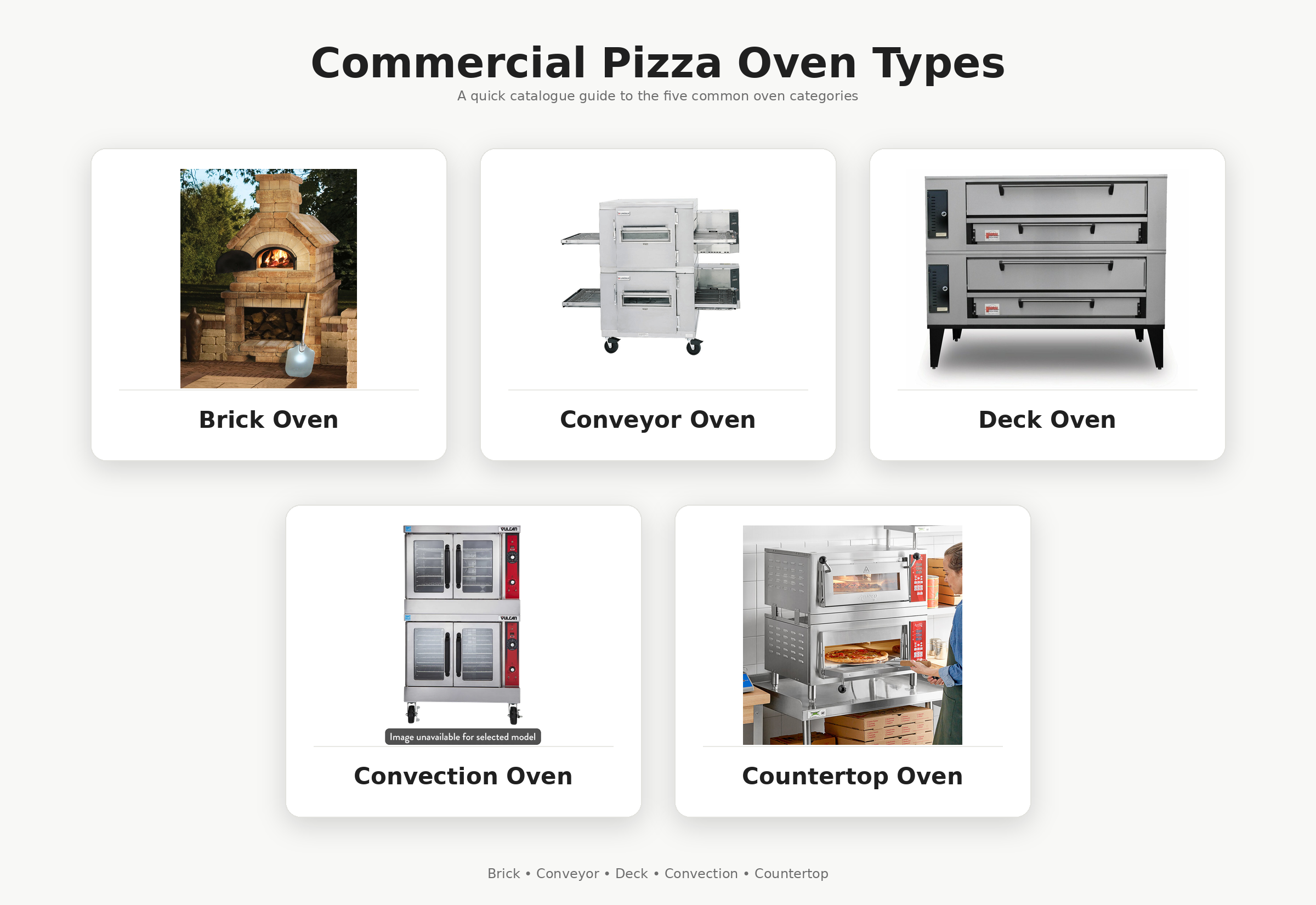
These categories are convenient for traditional equipment suppliers, but they are a little outdated because they don’t include some of the newer types of commercial pizza ovens on the market: specifically, around portability.
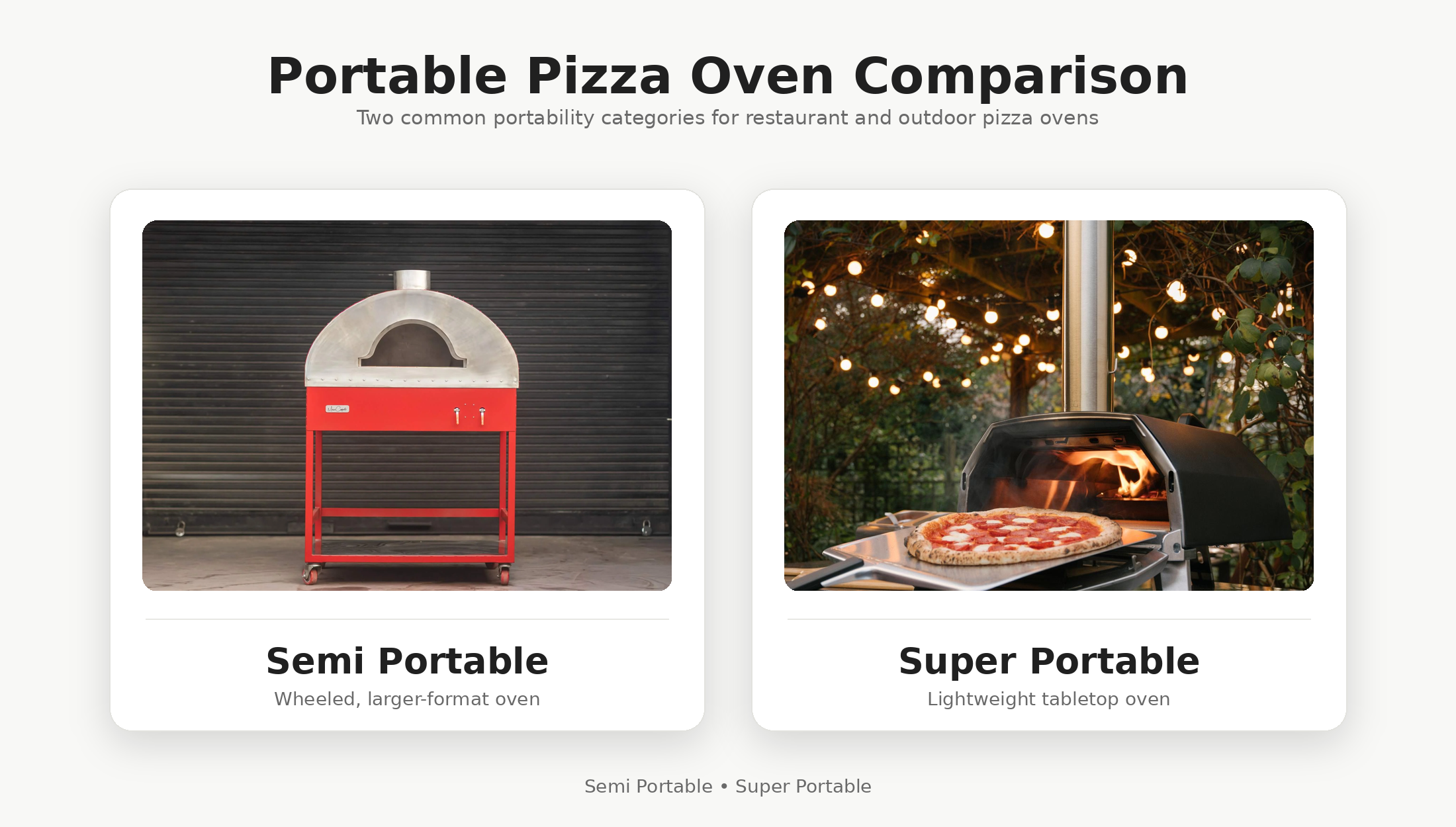
Up until this moment, you may not have thought about your pizza oven requirements beyond, you know, its ability to make decent pizza.
So you have two big ways to think about pizza ovens: oven format and fuel type.
| Approach | Pros | Cons |
|---|---|---|
| Super portable oven | Low cost, quick to buy, easy to move. | Low capacity, not built for serious daily service, and temperature recovery is poor. |
| Semi-portable oven | Better pizza quality and heat retention than a super portable oven, stronger wood-fired/artisan story, and flexible enough for pop-ups or early-stage service. | Heavier, more expensive, harder to move, and needs ventilation/fire-safety planning. |
| Brick / masonry / stone-hearth oven | Strongest visual appeal, great brand story, excellent heat retention, ideal for artisan/Neapolitan-style positioning, and can become the centrepiece of a restaurant. | Expensive and slow to install, needs space and ventilation, and requires skilled operation. |
| Deck oven | Strong commercial workhorse, consistent results, and easier to operate than live fire. | Less theatrical than a brick oven, needs serious electrical/gas setup, has long preheat times, and staff still need to rotate/manage pizzas. Not as hands-off as a conveyor. |
| Conveyor / impinger oven | Very consistent, low-skill operation, high throughput, great for franchise models, predictable cook times, and fewer mistakes during rush. | Weak artisan story, does not produce craft pizza, large physical footprint, expensive, and less flexible for varied pizza styles. |
| Convection oven | Cheapest commercial entry point, compact, easy to install and operate, good for cafés or side-menu pizza, and useful for testing demand. | Usually not true pizzeria quality, weaker crust unless using stones/steel, and limited heat intensity. |
| Countertop commercial oven | Space-saving, cheaper than full-size units, good for food trucks/pop-ups/small cafés, fast to deploy, and can be electric and simple to install. | Limited capacity, may bottleneck quickly, smaller pizza sizes, and not ideal for a serious pizzeria unless used as backup or test equipment. |
When it comes to fuel type, there are four main fuel approaches for commercial pizza ovens: wood-fired, gas-fired, electric, and hybrid wood + gas.
A wood-fired oven gives the strongest sense of romance and authenticity. It creates customer theatre, carries a powerful flavour association, and helps a restaurant stand out. The trade-off is that it takes more skill to operate. Wood-fired ovens need trained staff, careful fire management, good ventilation, regular fuel supply, and more day-to-day attention.
A gas-fired oven is usually the most practical commercial default. It is easier to control, faster to start, more consistent during service, and still capable of reaching high temperatures. It does not have the same romance as wood, and the flavour story is weaker, but for many restaurants it offers the best balance of heat, speed, and reliability.
An electric oven is clean, simple, and useful in locations where gas or wood is difficult. It can also be easier to approve indoors in some contexts because there is less smoke, fuel handling, and operational mess. The downside is that it may require a heavy electrical load, may have heat limitations depending on the model, and offers less theatre than a live-fire oven. Electricity cost and reliability can also matter.
A hybrid wood + gas oven offers the best balance of atmosphere and control. Wood gives the restaurant the story, theatre, and authenticity, while gas provides backup heat and makes consistency easier during busy service. The downside is that hybrid ovens are more expensive, more complex to install, and still require proper ventilation and operator training.
People assume choosing a pizza oven means wading through dozens of models and a wind tunnel of features. It doesn’t. Strip it back, and there are only four things that decide the right oven for you: output, space, fuel, and aesthetics. Work through them in that order, and the choice makes itself.
Start with output, because it does more to decide your oven than anything else. How many pizzas do you want to make in a day? This will depend entirely on your business model. If pizza is your main offering, you’re probably looking at serving over 100 a day — and a large venue might be at 300. If you’re just adding pizza to an existing menu, you’re likely under 100.
That 100-a-day mark is your first real decision point. Are you over the line, or under it? It splits the field cleanly:
| Serving under 100 pizzas/day | Serving over 100 pizzas/day |
|---|---|
| Super portable oven | Deck oven |
| Semi-portable oven | Conveyor / impinger oven |
| Convection oven | Brick / masonry / stone-hearth oven |
| Countertop commercial oven |
Total volume is a good place to start, but how uneven that volume is matters just as much. Are you serving five pizzas an hour, steadily, across a ten-hour day? Or do 80% of your pizzas land in one rush, while the other six hours you’re open, you sell 10?
This is where thermal efficiency comes in. If you only need five pizzas an hour, you don’t need a remarkable oven — there’s time for it to recover to temperature between bakes. But if you’re pushing 80 pizzas an hour, you’re launching more than one a minute, holding several at once, and every time a pizza comes out and another goes in, the oven cools. A thermally efficient oven holds its surface temperature right through the rush. The more pizzas per hour you need, the more this matters — and the more it’s worth paying for.
Once you know your output, the next limiting factor is space. How much room you have decides what you can physically accommodate.
If space is tight — a food truck, a small kitchen, mobile catering — it becomes the constraint, and the goal is the best performance you can get in the space available. If you’re designing a kitchen from scratch and building the venue around the oven, you have far more freedom.
| Small space | Medium space | Large space |
|---|---|---|
| Super portable oven | Semi-portable oven | Brick / masonry / stone-hearth oven |
| Countertop commercial oven | Deck oven | Conveyor / impinger oven |
| Convection oven |
One thing to keep in mind: bigger isn’t always better. The performance gap between a medium-sized oven and a conveyor can be negligible, while one is four times the size of the other.
Fuel choice follows the kind of pizza you want to serve — and what your site can support. Wood gives you romance and authenticity but demands labour, storage, and ventilation. Gas is the practical commercial default: high heat, fast startup, easy to control and train on. Electric is clean and simple where gas or wood is hard to install. And a hybrid lets you sell the wood-fired story while running on gas stability underneath.
| Wood-fired | Gas | Electric |
|---|---|---|
| Super portable oven | Super portable oven | Super portable oven |
| Semi-portable oven | Semi-portable oven | Countertop commercial oven |
| Brick / masonry / stone-hearth oven | Brick / masonry / stone-hearth oven | Convection oven |
| Deck oven | Deck oven | |
| Conveyor / impinger oven | Conveyor / impinger oven | |
| Convection oven |
The last question is aesthetics — and it’s the one with the most room for personal choice. If your whole business is built around pizza, it makes sense to put the oven front of house, where its look and feel become central to the room and the experience. A brick dome, a tiled mosaic, a copper-clad showpiece — these can be the visual centre of the restaurant.
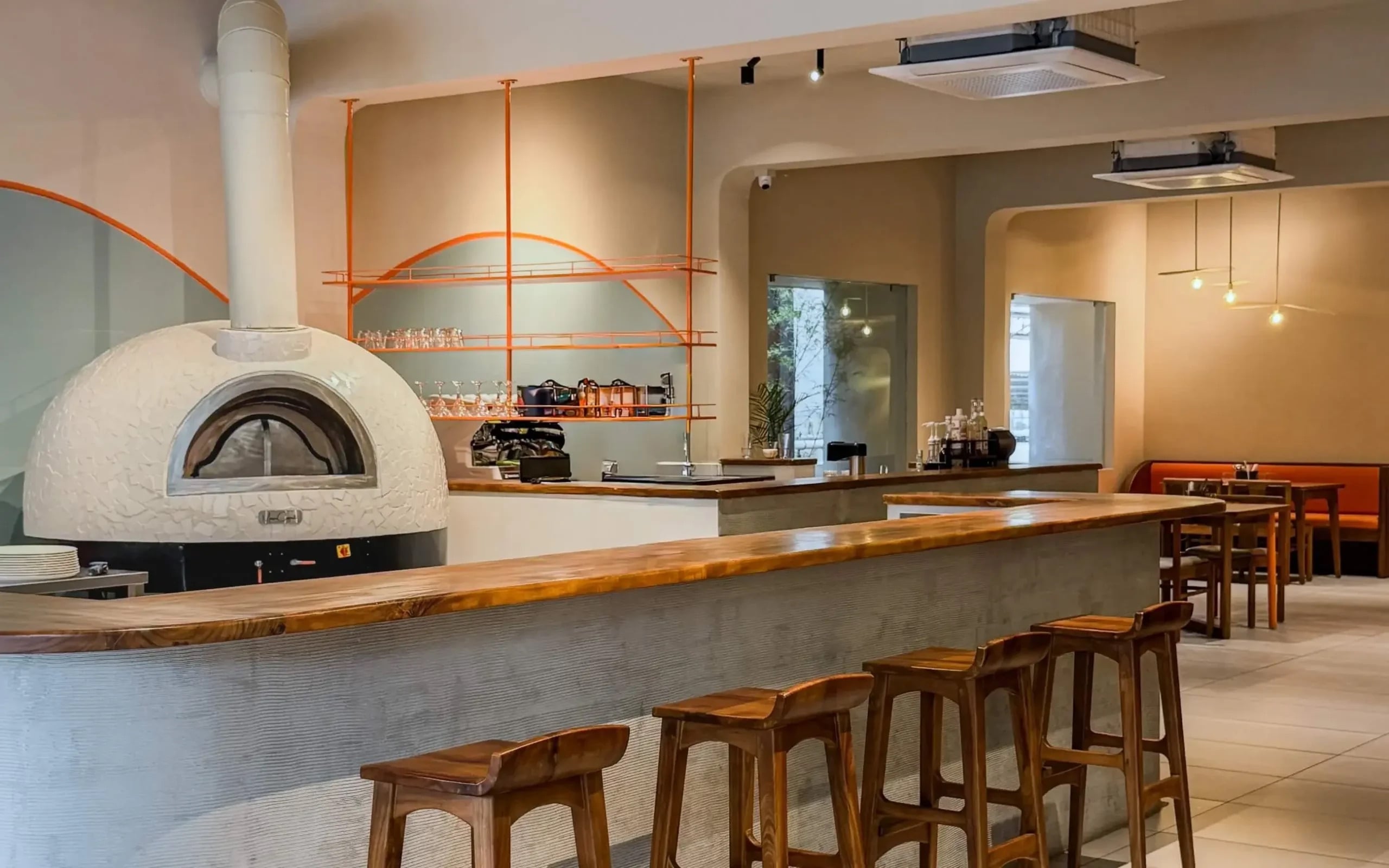
But if you’re a cloud kitchen and no customer will ever see the oven, the time and money that goes into a beautiful one is wasted. A conveyor or a stacked deck line is built for output, not ambience — and back of house, that’s exactly right.
The decision you absolutely have to get right is the first one: an oven matched to the number of pizzas you want to serve, and thermally efficient enough to hold up through your peak. This is the decision that determines how much of your profit potential you actually realise, because it’s set by the performance of the oven.
Once output is locked, the next question is how much space you have to work with — the goal is to get the performance you need into the room you’ve got. Then fuel, which follows the style of pizza you want to serve and what your site supports. And only once performance, size, and fuel are settled are you free to decide how much to invest in making the oven a statement piece for your venue.
There are other considerations, of course — you don’t want an oven that breaks down and needs constant maintenance, and you want it delivered safely. But those aren’t really decision points to weigh, because whatever you choose, you want it to be reliable and to arrive in one piece. They’re a given, not a trade-off.
Most sellers deliver an oven and leave you to figure out the rest. Marco works differently. His job is to take you from buy-to-bake.
He helps you pick the right oven for your space, output, and fuel type — you can get in touch with him via WhatsApp and start to explain your operation, and he will begin helping you navigate your options.
If you place an order for one of his ovens, he will customise it to your venue, and you can design it together for the perfect look and finish.
You don’t have to guess and hope a generic oven from a restaurant equipment guide works for you. Buying an oven can be hard and Marco help you navigate your options and get an oven that actually fits your business — the right size for your intended output, the right fuel for your setup, and a look, form and size that matches your venue — so the biggest part of the decision for your business is made with an expert who’s done it hundreds of times, and not on your own.
Taking you from buy-to-bake means that Marco is involved when the oven arrives and is being installed. He guides the initial firing process and walks you through the initial operation to produce your first round of pizzas. He cannot do this in person because we sell 100s of custom pizza ovens across India every year, but he will get on a video call with you and walk you and your staff through setup and maintenance, and handle any troubleshooting.
Every one of Marco’s ovens is built for a decade of commercial use. If anything ever goes wrong, Marco will send someone to your site to inspect and fix the problem at no cost. Providing a comprehensive after-sales service and not profiting from repairs is a deliberate and important part of Marco’s business model. Being on call means that he has to build ovens that don’t break in the first place. That way, he never wastes your time or his own on maintenance. When an oven needs repairing, it’s losing you and Marco’s money, so his incentive is to keep your downtime as close to zero as possible. On days when something goes wrong, Marco’s repair team’s job is to fix it fast and fix it thoroughly so that they never need to come back for another repair visit again.
I’ve used Marco’s oven for years at my Goa restaurant with great results. His prompt maintenance and excellent service led me to buy two more ovens.” — Imran Hai
Marco Cappiotti ovens are used by serious pizza operators across India — from boutique pizzerias to high-volume kitchens and five-star hospitality projects — backed by 700+ ovens delivered and 15+ years of expertise in the Industry
“Marco’s oven transformed my pizzeria. From unmatched build quality to ongoing support, it consistently delivers top-tier results.” — Casa Della Pizza, India
Da Susy and Leo’s, two of India’s most celebrated pizzerias and among the only Indian names to appear in global Top 50 rankings, both cook on Marco Cappiotti ovens. Da Susy is led by Susanna Di Cosimo, winner of the Best Pizzaiola award.
“I’ve used Marco’s ovens for 4 years, owning four of them. Their performance, heat retention, and craftsmanship are unmatched.” — Susanna Di Cosimo, Pizzeria da Susy
All of his ovens reach 450°C in 30–45 minutes, retain heat for up to 48 hours, and bake a Neapolitan pizza in 60–120 seconds — the heat recovery and consistency real commercial output demands. They’re covered by a 1-year on-site warranty and a lifetime guarantee against manufacturing defects.
If you’d like to explore working with Marco, get in touch through one of the forms on this site, or on WhatsApp — just click the icon in the bottom-right corner. Ask for our catalogues, and he will send you the latest models he’s working on.
He will probably start the conversation by asking you a few questions about your operation — the kind of venue you’re running and how many pizzas a day you intend to produce, and then he can help you navigate the options for the right oven for your business.
Buying an oven is hard. Why do it on your own?